

- About TCB
- Sewing Machines for TCB
- TCB Crews Introduction
- News / Daily
- Shop / Stockists
- Repair & Hem
- Recruit
- Contact


2026/04/14
大戦モデルを2つ作っていることもあり、
「S40’sとLate S40’sの違いは?」
という質問を本当によく頂きます。
今日はその中でも、生地の違いについて。
まず結論から言うと、
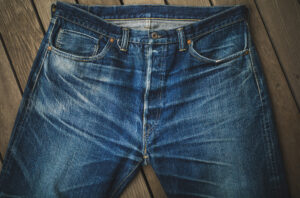
この2つは色が全然違います。
S40’sは濃く、
Late S40’sはやや淡い青。
ただこれは、
「どちらがヴィンテージに近いか?」
という話ではありません。
どちらも近い。
これが僕たちの答えです。
僕たちの解釈では、
大戦モデルの魅力は
10本あれば10通りの表情があること。
それは縫製仕様だけでなく、
生地も同じです。
だからTCBでは、
一つの正解ではなく、
異なるヴィンテージを元に2つの生地を作りました。
■ S40’s
最初に作ったのがS40’s。
大戦モデルを解体し、
糸の繊維レベルまで解析して作った14ozの生地です。
イースタンメンフィス、ニューオリンズ、テキサス。
3種類の米綿をブレンドし、機械設定で自然なムラを作りました。
さらに、ヴィンテージ特有のコシ感を再現するため、
強撚で紡績し、あえてゴワっとした表情に。
綿の白度も調整し、
当時の少しくすんだ色味を再現しています。
これは少し妄想も含みますが、
戦時中は軍需が優先され、
民間で使えるコットンの質は下がっていたはず。
結果として、繊維長の短い綿を使い、
それを成立させるために強撚で紡ぐ。
その結果、
硬くて粗野な生地になる。
そんな背景を想像して作ったのがS40’sです。
だからこそ、
濃色+ゴワつき=強いコントラストの色落ち
が特徴です。
■ Late S40’s
一方のLate S40’s。
まず分かりやすいのは、
少し青みのある淡い色味。
S40’sを発表して数年、
多くのヴィンテージを見る中で、
「大戦モデル=この生地」ではない
という仮説が自分の中で整理されてきました。
そんな中で出会ったのが、
ネルポケットのヴィンテージ。
これを見た時に、
「もう一つの答えとして作る意味がある」
そう思いスタートしました。
こちらも分析機関に出し、色を再現。
さらに今回は糸作りで新しい試みをしています。
当時は糸の太さを均一に保つのが難しく、
結果としてムラ糸になっていた。
でも僕たちが思ったのは、
そのムラは本当に“一つの番手”で表せるのか?
ということ。
そこで今回は、
経糸に2種類の糸を混ぜました。
・7.5番(弱くて長いムラ)
・6.5番(強くて短いムラ)
これをミックスすることで、
より複雑でリアルな表情に。
緯糸には6番手を使用し、
全体のバランスを整えています。
■ 最後に
店頭ではよく聞かれます。
「どっちの色落ちが良いですか?」
「Lateは廉価版ですか?」
でも僕たちにとっては、
そういう上下の関係はありません。
どちらも違う答え。
どちらにも、
同じだけの時間とストーリーを込めています。
Late S40’sはまだサンプルが少ないですが、
ぜひ実際の色落ちを見比べながら、
それぞれの違いを楽しんで頂けたら嬉しいです。
近いうちに、
S40’s JacketとLate S40’s Jacketの違いも
お話しできればと思います。
Since we produce two WWII models,
we often get asked:
“What’s the difference between the S40’s and the Late S40’s?”
Today, we’d like to focus on the fabric.
First, the conclusion:
These two are completely different in color.
The S40’s is darker,
while the Late S40’s has a lighter, slightly bluish tone.
But this is not about
“which one is closer to vintage.”
Both are.
That’s our answer.
In our view,
one of the key charms of WWII denim is that
if you line up ten pairs, you’ll see ten different expressions.
This doesn’t only apply to construction details,
but also to the fabric itself.
So instead of chasing a single “correct” answer,
we created two fabrics based on different vintage references.
■ S40’s
The first one we developed was the S40’s.
We deconstructed an original WWII pair
and analyzed it down to the fiber level
to recreate this 14oz fabric.
We blended three types of American cotton
from Eastern Memphis, New Orleans, and Texas,
and adjusted the machine settings to achieve a natural irregular texture.
To replicate the firmness found in vintage denim,
we spun the yarn with a high twist,
intentionally creating a rough and rigid feel.
We also adjusted the cotton’s whiteness
to reproduce the slightly muted tone seen in old fabrics.
This part involves a bit of imagination, but—
During wartime,
cotton was prioritized for military use,
making it harder for civilian clothing to access high-quality materials.
As a result, shorter staple cotton had to be used,
which required stronger twisting during spinning
to make the yarn hold together.
And that naturally led to
a rough, rigid fabric.
That’s the story we had in mind when creating the S40’s.
Because of this,
the S40’s is characterized by
deep indigo + rigidity = strong contrast fades.
■ Late S40’s
On the other hand, the Late S40’s.
The most noticeable feature is
its lighter, slightly blue tone.
A few years after launching the S40’s,
we had the opportunity to study a wide range of vintage pieces—from deadstock to heavily worn pairs.
Through that experience,
we began to realize:
“WWII denim doesn’t mean just one type of fabric.”
That’s when we encountered
a vintage pair with flannel pocket bags.
At that moment,
we felt there was meaning in creating
another interpretation.
Just like the S40’s,
we sent the fabric for scientific analysis
and recreated the color.
But this time, we also experimented with the yarn itself.
Back then, it was difficult to maintain a consistent yarn thickness,
which naturally resulted in what we call “slub yarn.”
But we started to question:
Can that irregularity really be defined by a single yarn count?
So for the Late S40’s,
we used two different yarn types in the warp:
#7.5 yarn (long, subtle irregularity)
#6.5 yarn (short, stronger irregularity)
By mixing these,
we created a more complex and realistic texture.
For the weft,
we used #6 yarn to balance the overall structure.
■ In Closing
We’re often asked in-store:
“Which one fades better?”
“Is the Late S40’s a lower-tier version?”
But for us,
there’s no hierarchy between them.
They are simply two different answers.
Both are made with the same level of care,
thought, and storytelling.
The Late S40’s still doesn’t have as many aging samples yet,
but we hope you’ll enjoy comparing the fades over time
and discovering the differences for yourself.
We’ll also be sharing
the differences between the S40’s Jacket and Late S40’s Jacket
in the near future.






 Categolies
 Tag
Tag Archive